
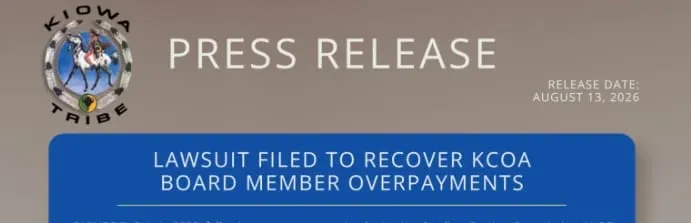
In August of 2026, the Kiowa tribe posted a press release that informed of a recent lawsuit filed against former KCOA board members.The press release claimed in 2023, an anonymous tip led to the National Indian Gaming Commission (NIGC) issuing a Letter of Concern to the tribe regarding “a potential misuse of gaming revenues.” The focus of the letter was the stipends awarded to five KCOA board members including Luke Yeahquo, Joe Poe Jr., Susan Dunlap, Richard McMahon, and James Kennedye and payment for “non-quorum meetings.” The payments took place during their term which lasted from 2017 to 2020.
Ultimately, the letter claims that the stipends allotted to the board members were “excessive” and in violation of the KCOA Charters that limit the amount of compensation board members can receive. Dark Roast spoke with Richard McMahon and Joe Poe Jr., two of the accused board members, who said they felt there were several unfair factors to the case, with the first being the fact that the standards applied to board members compensation was subject to changing. Poe said that when that board had been elected, the numbers that reflected what the board could be paid were in line with what they received but that they had been decreased by the time the investigation came to be.
"The KCOA did not independently determine or authorize its own compensation. The compensation in question was reviewed, approved, and vetted through the tribal government at the time,” McMahon said
In response to the letter, the Chairman of the tribe at the time, Lawrence Spottedbird ordered an investigation into the board members and demanded that they pay back the funds. McMahon said that not long after that, Spottedbird accepted a meeting with the board members to give them an opportunity to plead their case. After this meeting, Spottedbird notified the NIGC that he believed the payments to be fair and tried to have the case dismissed but the NIGC denied the request and continued their investigation.
Spottedbird was later impeached and removed from office and Chairman David Sullivan took over. Sullivan reviewed the file and removed McMahon as Chairman of the board and filed a civil lawsuit against five former KCOA board members and reiterated the demand that they pay back the funds.
In the press release, Sullivan stated:
“As Chairman, I have a duty to protect the tribe’s assets and ensure the integrity of our gaming operations. When our review finds the tribe’s funds have been misused, we have the responsibility to seek reimbursement.”
McMahon and Poe say they have reached out to Sullivan to request an opportunity to meet and share their side of the story but said their request has not been accepted. Now, the former board members claim they have not been given a fair opportunity to present their side of the story and added that they feel the tribe’s coverage of the situation has shone a negative light on them and has impacted their personal and professional lives.
“The current tribal leadership has publicly called into question our names and reputations over what we believe was a tribal governmental oversight and administrative failure that was outside our individual control,” McMahon said.
McMahon and Poe said another issue they felt presented an unfair factor in the case was who submitted the anonymous tip in the first place. While Poe admitted that they didn’t have concrete evidence, he and McMahon suspect that the tip came from a "disgruntled employee” who they claim had been fired as a result of them calling attention to concerning actions by that individual. They expanded on this, explaining that they ultimately felt they had been terminated from their positions for “engaging in whistleblower activity.”
McMahon said he and the other board members in question have compiled what he described as evidence and supporting documents “concerning approximately a decade of tribal governmental and financial issues.” These documents detail incidents from periods earlier than when the board members in question were serving together, including the periods of time in which Dunlap and Poe oversaw the KCOA. The documents include several instances where different board members filed litigation against Komalty, a former chairman, for circumstances involving finances. They noted that these generally resulted in someone losing their position. McMahon stated that he and the other board members believe these series of litigations intended to shine a light on financial wrongdoings play a significant role in their current situation.
In March, Poe sent a letter to Chairman Sullivan requesting a due process hearing. In the letter, Poe urged the Chairman to provide the board members in question their due process, emphasizing that it was their right. It went on to detail that SpottedBird had given the board members a chance to present their case, but that they don’t feel Sullivan was being fair in not providing the same chance. The letter is signed by the participating four board members.
Dark Roast Report reached out to Chairman Sullivan several times to get his perspective on the situation, but received no response.
“The state can’t take away your life, liberty, or property unless it follows fair procedures and laws. There exist fair procedures before the government acts against someone. Citizens are entitled to a notice of charges or action, a fair and impartial hearing, an opportunity to present evidence, and the right to an attorney,” the letter stated.
Also included in the documents is the response letter that was sent to the NIGC. It details the amounts that board members were allowed to receive from 2017 to 2020 and how those numbers changed over time due to amendments. According to the letter, those are as follows:
- 2017 - From 2017 to April, 14, 2018 the rate of compensation for KCOA trustees was expressly set in the Fifth Amended Charter at $300 per meeting with no more than 24 meetings per year.
- 2018 - On April 24, 2018, the Tribe enacted the sixth amended charter of the KCOA, which limited the KCOA trustee compensation at an amount “as set an approve Annual Budget or Budget Modification.”
- 2018 - On October 13, 2018, the voters of the Tribe approved a new Annual Budget for the tribe, which included the following statement on the ballot used by the voters and which appeared under the heading “General Budget, Executive Branch:” (In pertinent part):
KCOA Board Meeting fees: $36,000.00
($300/meeting X 5 Trustees X 24 meetings)
- 2019 - On August 24, 2019, the voters of the tribe approved a new Annual Budget for the tribe, which did not include compensation for the KCOA Trustees or compensation for the KCOA Board was not included in the Tribe’s budget as required by the Constitution, however, the Casino had included compensation for the KCOA Board in its budget.
- 2020 - On August 22, 2020, the voters of the Tribe approved a new Annual Budget for the Tribe, which did not include compensation for the KCOA Trustees.
The letter then noted that while the KCOA Board wasn’t listed in the budget it could be assumed that they would be compensated for their work, as they had been in the past, under the policy in which they were allotted $300 per meeting, with no more than 24 meetings a year. The letter then noted the lack of clarity around the detail as a communication issue between the Executive Branch, the Legislature, and the KCOA. It then went on to explain that the KCOA was included in the casino budget but that budget was in violation of the amended charter. The letter was signed by SpottedBird.
“The board performs an essential function and it would be very difficult to find qualified Board Members willing to serve for no compensation,” the letter stated.
A Findings letter issued in response to the situation later claimed that SpottedBird and McMahon had continued to “doggedly dodge the accountability explicitly mandated by the NIGC in the LOC.” The letter then went on to list the totals each board member received between 2017 and 2020, which it presented as follows:
- Dunlap - $110,500
- Poe - $110,150
- McMahon - $40,500
- Kennedye - $17,000
- Yeahquo - $23,000
“In his October 2025 testimony, Chairman SpottedBird confirmed that the specter of civil penalty – a substantial monetary fine, or subjection to a closure order – continues to loom over the Tribe as a possibility. Despite this, the Chairman has not only floundered at sustaining a coherent response to the NIGC but actively misled them about his posture toward their inquiry,” the letter added.
Poe and McMahon said that the Amended Charters and lax regulations have created financial discrepancies in many instances, which is why they take such issue with the level of attention that’s been brought to their case. They alleged that Attorney Robert Lyttle’s handling of funds resulted in the Kiowa Tribe no longer fulfilling his invoice, which they claim is a trend that began during his time working for previous tribes. McMahon and Poe expanded, claiming that the loose tracking of funds was a trend they had witnessed in the Tribe before, and they aren’t the only ones to note that detail.
Bryan Womack, who is a member of the Kiowa tribe explained that he has done his own research on how the tribe as a whole manages its finances. He’s paid particular attention to the tribe’s most recent Constitution which he views as “invalid.” He pointed out that Robert Lyttle is the Attorney over the Constitution.
One of Womack’s biggest issues with tribal regulation is how funds are managed. While Womack admitted that he doesn’t exactly see eye-to-eye with all of the KCOA Board Members, he said he does feel that the lawsuit is hypocritical.
“In the grand scheme of things, those payments are small compared to the millions that we have no clue on. What they are all up in arms about is what we have on record, and that data lacks the necessary controls year after year,” Womack said.
He said he believes many of the current issues are due to how Komalty and SpottedBird managed things and added that no one is charged with overseeing finances and that even grants and federal money are loosely monitored. However, he also expressed concerns over how Sullivan is running the Tribe and feels he does not effectively communicate with tribal members.
“What I would love for someone with social clout to do is call him out for not addressing any of these things that have been pushed off to SpottedBird over the years, then to him,” Womack said.
McMahon shared that the board members had filed a motion to dismiss the case, which he inferred was denied because the board members were scheduled for a court hearing. The hearing is set to take place on November 10.







Comments