
The campaigning for Wichita Falls’ next mayor has been underway as early voting is concluding and election day is just around the corner. So far, over 20,000 people in Wichita County have participated in early voting, but for those who haven’t, there’s still time to do research to prepare for the election.
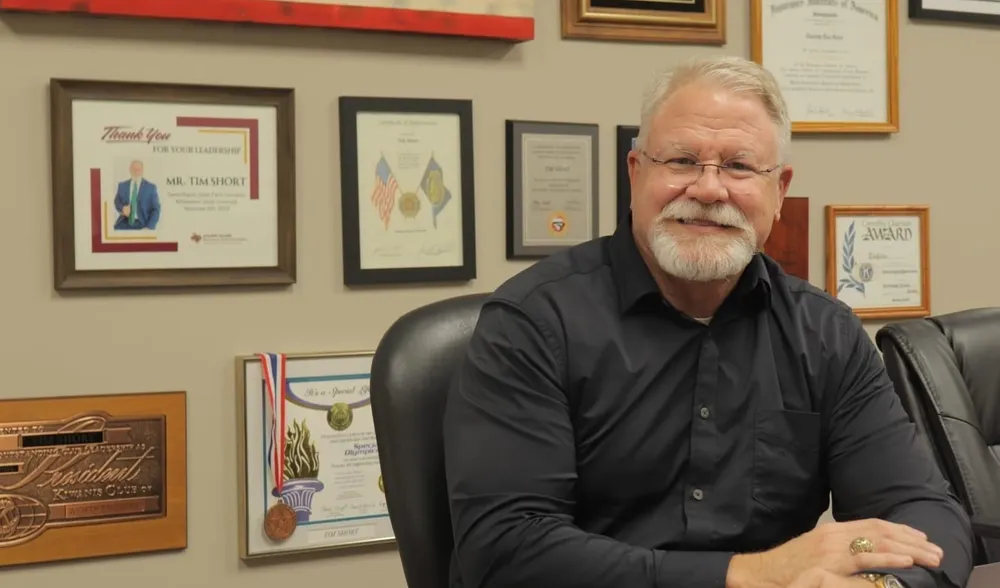
In an effort to give the community a better understanding of the mayoral candidates that will appear on the ballot, Dark Roast Report has reached out to both candidates and conducted interviews with the same questions that explore who each candidate is and what they say motivates them to run. Dark Roast Report sat down with current Mayor Tim Short to get his personal and professional take on running. Short is opposed by local businessman Scott Poenitzsch.
Short said he’s lived in Wichita Falls for around 27 years, having moved here for his job with State Farm in 1999. Short said he appreciates how the job allowed him free time to get involved in the new community that he would come to be a part of. He noted that the primary ways he did this were through coaching baseball and volunteering for local nonprofits like Meals on Wheels.
“I believe everybody should engage in their community. I think, otherwise, why be a part of it,” Short said.
The longer Short worked with these organizations, the more involvement he obtained in the decision-making process for some nonprofits. The primary example of this he gave was the 100 Club of Wichita Falls, an organization established several decades ago to provide financial support and assistance to the widowed spouses of first responders. Short said he served as the President of the board for several years.
Fortunately, he mentioned that not many spouses of first responders were widowed in the community, leaving a surplus of unused funds. When the funds weren’t being used, the board determined that they should be used to assist first responders instead. Short explained that they use the funds to assist law enforcement and firefighters with obtaining updated equipment and technology. Short said helping to answer this need that he recognized in the community is one of the things that led him to pursue public service.
Further, Short mentioned that he’d been living in Wichita Falls a while when the vote for the bond to build the schools took place. He noted that the situation stood out to him because people who had lived in Wichita Falls and grown up in that very school system were seeing growth there and hoping to see more in the greater community. Short added that he believed that in order for people who grew up in Wichita Falls and went to MSU to stay in the community, there needed to be more opportunities. He said that momentum for growth was another thing that struck his interest in a public leadership role.
Short said he was friends with previous mayor Stephen Santellan when his term was coming to an end and said he was encouraged by friends and family to run. After campaigning for a year, he was eventually elected as Mayor.
Short likened Wichita Falls to Mayberry and said that one of the greatest strengths of the city is the kindness and community-oriented approach of the people that call it home. He did mention that he wishes there were more outlets for people to get involved in the community and said he’d like to see people get involved in civic clubs again and that he believes the lack thereof is due to a ‘generational gap.” However, he ultimately highlighted the willingness people in Wichita Falls have to help others. Another thing that Short brought up as an advantage of Wichita Falls is its close proximity to other cities and its room to grow.
With the desire to help Wichita Falls grow being one of the motivating factors in Short’s pursuit of becoming Mayor, he brought up how his efforts to appeal to outside companies he believed were a good fit was a large part of implementing that goal. He explained that the process involves inviting company leaders to the city, taking them to get a cowboy hat, taking them to all the best restaurants, and taking them to the rodeo over a span of a few days before “sending them home to tell everybody about Wichita Falls.”
Short said he believes Amazon is a shining example of how well that process works. The Amazon facility. Located in the industrial zone of the city, has been in the community for around a year now. Short claims the facility has provided jobs and hasn’t been a disruption to civilian life, despite the concerns he said some members of the community shared when it was in the process of being added to the city. Short said such growth efforts are why he’s decided to run again – so he can continue working toward that goal.
“All of these things are bigger than me and they can go on without me, but I’ve been there for the ground-breakings and I would like to be there for the ribbon cuttings over the next couple years. I’d like to finish some of the things we got started,” Short said.
Still, he acknowledged that there are still downsides to the job, such as how hard it is on his friends and family to deal with the associated pressure and stresses associated with a public service role. Short said he values the trusted relationships of his friends and family and said it’s their advice and support that keeps him going.
Short admitted that he’s learned a lot since he first ran and said the connections he’s built during his time as Mayor have helped his understanding and support system. He said, for this campaign, his focus is the people.
He credits many of his best ideas to the people directly dealing with the issues and said the ideas “come from the bottom up.” He said he wants people to feel like they can approach him with issues.
“They tell me about things and, while government rarely solves the problem, if it’s something we can take care of, we will,” Short said.
Short went on to add that during his first campaign, he “wanted Wichita Falls to be the Chick-fil-A of cities” where the focus was on how they could help. He said he feels he made steps toward that during his first term through public-facing offices for city officials and quick responses to phone calls – to the point that the city didn’t need an answering machine. Short said he hopes to maintain and improve on that approach if he’s re-elected.
In addition, if he’s re-elected, Short said there are few particular areas of Wichita Falls he’d like to work toward improving, such as the Eastside and Northside. He expanded on this by saying that he couldn’t fix the flooding issue in Eastside in three years, but that he’s hoping to continue that process if re-elected. He also mentioned TIF Zones and how the District Two zone had been neglected before the city recently determined new board members to govern it so that growth efforts could take place. He stated that no one from Eastside had been on the board before then but now several members from the area represent it.
“There are actively things happening that weren’t happening three years ago, and it was never neglected on purpose but nobody was doing anything,” Short said.
He said if given another term, his focus would ultimately continue to be on economic development and strengthening the relationship with Sheppard Air Force Base. He also mentioned that for downtown to grow, there would need to be more involvement from private owners and that he felt downtown is exactly what a downtown should be with things to do and see. He said he wants economic growth across the whole city and doesn’t want the division of districts to be a part of that conversation, except when it comes time to vote.
Short also mentioned that he feels this campaign season has been particularly divided and difficult to navigate. He said he feels social media is a large contributor to that because it provides a platform for opinions without discussion. He also mentioned that he felt more people from nearby communities were chiming in on Wichita Falls matters without even living here. He said despite the division he’s experienced, he plans to take a responsive, personal, and people-oriented approach to communicating.
He said that he believes transparency and communication are important in establishing trust with the community but that he believes “misinformation” can disrupt that. With the data center as an example, he said he believes people don’t fully understand data centers so they’re afraid of them. He claimed that residents’ willingness to get a big company like Buccees in town, but not Skybox was hypocritical. He said, in actuality, the data center’s resource usage would be like “a couple of Sonics.” He also mentioned how regulated Data Centers are.
Short said he feels the city commonly has to correct misinformation around such topics. He said he feels the city has to “play defense” and it shouldn’t have to. He did note that he feels the city can always do better with communication.
“You tell the truth and then you don’t have to remember what you said," Short said.
As far as being involved, Short said he doesn’t feel like he could possibly more involved between work, being Mayor, volunteering, and family time, but he hopes more opportunities to be involved in the community will become available. He said if he’s re-elected, he will invite more community feedback for how such growth and community resources should be approached. While Short said he prefers face to face meetings for such communication, he added that he intends to create more avenues for community members to participate in public meetings and possibly even through online platforms such as video chat. Short admitted that public officials should be able to answer residents’ questions and that if re-elected, he hopes to find better methods to achieve that.
“If there’s anything really that we’ve learned, it’s that there has to be more public input, and while I don’t think three years ago there was as great a thirst for it from the public, I think there is now. This is where we’ve evolved to and so we have to meet that expectation,” Short concluded.
To learn more about Short’s opponent, Scott Poenitzsch, you can read his preview here.











Comments